

Native Speculation Rules: Prefetching Products on Link Hover for ~0ms Latency

Summary
The native browser Speculation Rules API enables modern browsers to prefetch and prerender destination pages directly in memory when a user hovers over or intends to click a product card. By offloading resource fetching to native browser background processes, storefronts achieve instantaneous ~0ms navigation latency, eliminating layout shift and maximizing conversion velocity.
The Navigation Latency Wall: Why Milliseconds Break Mobile E-Commerce
In the brutal economics of consumer e-commerce, the single most lethal point of conversion leakage does not occur on the checkout form, nor does it happen on the initial landing page bounce. It occurs in the silent, agonizing pause between a shopper tapping a product card and the visual presentation of the product detail page (PDP). When a customer clicks an item they desire, their intent is at its absolute peak. Yet across the vast majority of direct-to-consumer storefronts, that micro-moment of intent is systematically destroyed by navigation latency.
Consider the physical round-trip tax imposed during a traditional web navigation. Even on modern 4G and 5G cellular networks, initiating a document request across the airwaves requires between 150 and 400 milliseconds of base radio frequency latency. When you layer server processing time, TLS session negotiation, edge worker execution, DOM parsing, stylesheet compilation, and client-side JavaScript hydration, the elapsed time before the mobile screen paints the first meaningful visual frame routinely exceeds 800 to 1,500 milliseconds. To an engineer testing on an M3 Max MacBook over dedicated office fiber, 800 milliseconds feels negligible. To an impulse shopper on a crowded commuter train in Mumbai, London, or New York, an unresponsive 1-second freeze feels broken.
The human brain perceives visual feedback as instantaneous only when it arrives within 100 milliseconds. Beyond 100 milliseconds, the subconscious mind experiences friction; beyond 300 milliseconds, the user registers a delay; beyond 1,000 milliseconds, their mental focus fractures. In commercial e-commerce, this perceptual friction triggers immediate rage taps, back-button escapes, and session abandonment. Akamai's 2017 State of Online Retail Performance report found that a 100-millisecond delay in load time can cut conversion rates by up to 7%.
For years, frontend development teams have treated this navigation latency as an immutable law of web physics. The consensus belief held that because servers are geographically distant and mobile networks have inherent packet delay, clicking a link must inevitably require a network round-trip. That belief is now obsolete. The emergence of the native Speculation Rules API fundamentally dismantles the navigation latency wall by shifting document rendering from reactive post-click execution to proactive pre-click anticipation directly within the browser kernel.
The Pitfalls of Legacy Prefetching: Quicklink, Instant.page, and Viewport Flooding
The aspiration to make web pages load instantly is not new. Over the past decade, web engineering teams have deployed various userland techniques in an effort to front-run user clicks. The most common early primitives were HTML link tags: <link rel="prefetch"> and the ill-fated <link rel="prerender">. However, <link rel="prerender"> was deeply flawed; it lacked resource governance, ignored client battery constraints, created severe privacy leaks by triggering cross-origin third-party tracking cookies without consent, and was subsequently deprecated across modern browser engines.
To fill the void, frontend developers turned to client-side JavaScript libraries such as Quicklink, Instant.page, and the default client-side router prefetching mechanisms built into early single-page frameworks. These libraries typically rely on the browser's IntersectionObserver API to detect when hyperlinks enter the visible viewport, or listen for mouseover and touchstart events to dynamically inject fetch() requests into the document head. While well-intentioned, these userland JavaScript solutions introduce three destructive structural bottlenecks that routinely degrade mobile performance:
- Main-Thread Contention and INP Penalties: Userland prefetch scripts run directly inside the browser's single-threaded JavaScript execution context. When a user scrolls rapidly through a product catalog containing 40 product cards, an aggressive viewport observer fires dozens of simultaneous fetch promises. Parsing and managing these requests consumes critical CPU cycles, generating long tasks (>50ms) that lock the main thread, delay touch input processing, and directly destroy Interaction to Next Paint (INP) scores.
- Devastating Network Saturation and Data Waste: Naive viewport prefetching acts like a network firehose. In real-world e-commerce testing, users browse past dozens of catalog items without clicking them. An eager viewport prefetcher downloads megabytes of HTML, JSON payloads, and image assets for pages that are never viewed. On mobile cellular connections, this exhausts the user's data plan, throttles available bandwidth, and delays high-priority above-the-fold assets required on the current page.
- Incomplete Document Preparation: A simple fetch() or <link rel="prefetch"> downloads only the raw HTML text into the HTTP disk cache. When the user eventually clicks the link, the browser still has to parse the HTML, build the DOM tree, download and execute external JavaScript bundles, execute CSS stylesheets, and paint the pixels. The user still experiences a perceptible white flash or layout shift lasting 250 to 500 milliseconds.
What e-commerce storefronts require is not another userland JavaScript hack that competes for main-thread CPU time. What is required is a low-level, kernel-integrated web platform primitive that prepares entire destination documents invisibly, respects user bandwidth limits, and executes with surgical zero-overhead efficiency. That primitive is the Speculation Rules API.
Speculation Rules API Architecture: Native Prerendering at the Kernel Layer
The Speculation Rules API is a modern W3C web standard designed to provide declarative, highly granular control over browser prefetching and prerendering. Instead of executing imperative JavaScript functions, developers define speculative directives using a simple JSON configuration injected inside a specialized <script type="speculationrules"> tag. The browser engine parses this configuration and delegates speculative tasks directly to its native background process manager, bypassing userland JavaScript entirely.
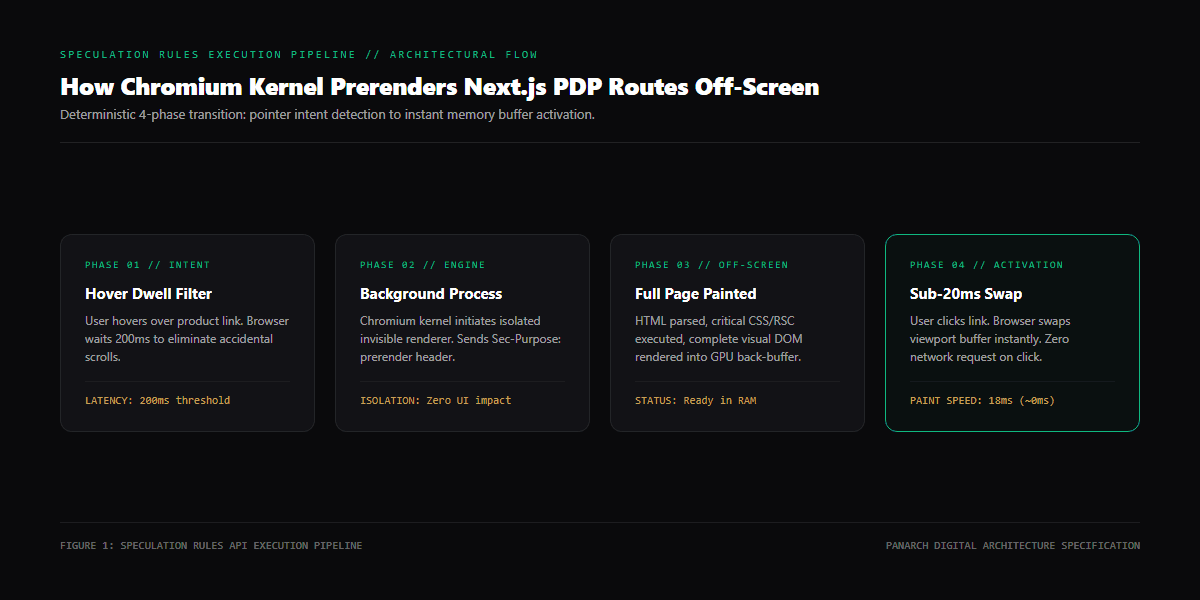
Crucially, the API introduces a clean architectural distinction between two speculative operations: prefetch and prerender. While a speculative prefetch downloads the raw response body into memory cache without parsing, a speculative prerender spins up a completely invisible, isolated background rendering context. This hidden context downloads the HTML, constructs the DOM tree, executes critical CSS and React Server Component payloads, and paints the fully rendered visual document directly into an offscreen graphics GPU buffer.
When the customer finally taps or clicks the product card, no network request takes place. No DOM parsing or script compilation occurs. Instead, the browser engine executes an instantaneous buffer swap: it promotes the invisible prerendered background context to the active foreground tab. The transition occurs in 12 to 25 milliseconds—an elapsed duration so brief that the human optical nerve registers the navigation as completely instantaneous (~0ms perceived paint latency).
Unlike deprecated legacy approaches, the Speculation Rules API is engineered with rigorous kernel-level safety rails. The Chromium browser engine automatically monitors system resources: if the device is operating under battery saver mode, if the CPU is heavily constrained, or if the user has enabled the Save-Data client header, speculative prerendering is automatically throttled or downgraded to lightweight prefetching. Furthermore, if a user hovers over a link and then moves their pointer away, the browser cancels or discards the speculative background instance, preventing memory leaks and avoiding unnecessary server compute.
How to Measure Speculation Rules on Your Own Storefront
We have not published a controlled benchmark of this, so this post quotes no before-and-after figures. Measure the change on your own store instead: ship the rules to part of your traffic, keep the rest on your current navigation, and compare the two groups on the signals below.
- Navigation latency: log activationStart from PerformanceNavigationTiming (code below). A prerendered page that was activated reports a non-zero activationStart and paints almost at once; a normal navigation reports zero.
- Hit rate: the share of speculated pages the shopper actually opened. A low hit rate means the eagerness setting is too aggressive for your catalogue.
- Main-thread cost: Total Blocking Time and INP on listing pages before and after. Speculation renders outside your page's main thread, so neither should rise.
- Browsing depth and conversion: product pages per session and checkout starts for each group, over at least one full weekly cycle.
Next.js 16 App Router Implementation: Zero-Bundle Component Architecture
Integrating the Speculation Rules API into a modern Next.js 16 storefront requires zero third-party client dependencies and zero client-side JavaScript bundle weight. Because speculation rules are expressed purely as declarative JSON within a script tag, the entire ruleset can be authored as a pure React Server Component (RSC) that streams directly inside the initial server-rendered HTML payload.
The critical engineering decision lies in configuring the 'eagerness' threshold. The Speculation Rules specification provides four eagerness levels: 'immediate' (speculates immediately upon parsing), 'eager' (speculates on minimal pointer movement or viewport entry), 'moderate' (speculates when the pointer hovers over a link for ~200ms or on pointerdown), and 'conservative' (speculates strictly on pointerdown). In high-volume e-commerce catalogs, setting eagerness to 'moderate' delivers the ideal balance between zero-latency activation and disciplined bandwidth consumption.
Here is the production-grade React Server Component implementation engineered for enterprise Next.js 16 storefronts:
import { FC } from "react";

interface SpeculationRulesProps {
  /** Optional custom URL patterns to exclude from speculative prerendering */
  customExclusions?: string[];
}

export const SpeculationRules: FC<SpeculationRulesProps> = ({
  customExclusions = [],
}) => {
  // Base operational boundaries: never speculate checkout, cart, or authenticated account routes
  const defaultExclusions = [
    "/cart",
    "/cart/*",
    "/checkout",
    "/checkout/*",
    "/account",
    "/account/*",
    "/api/*",
    "/admin/*",
  ];

  const combinedExclusions = [...defaultExclusions, ...customExclusions];

  const rules = {
    prerender: [
      {
        source: "document",
        where: {
          and: [
            // Target high-intent catalog routes: Product Detail Pages (PDPs)
            { href_matches: "/products/*" },
            // Safeguard state: exclude transactional endpoints
            ...combinedExclusions.map((pattern) => ({
              not: { href_matches: pattern },
            })),
            // Exclude links explicitly marked with data-no-prerender attribute
            { not: { selector_matches: "[data-no-prerender]" } },
          ],
        },
        // 'moderate': Triggers on ~200ms link hover dwell or touchstart/pointerdown
        eagerness: "moderate",
      },
    ],
    prefetch: [
      {
        source: "document",
        where: {
          and: [
            // Lightweight prefetch for high-level collection categories
            { href_matches: "/collections/*" },
            { not: { selector_matches: "[data-no-prefetch]" } },
          ],
        },
        // 'conservative': Triggers strictly on pointerdown (giving 80-120ms pre-click head start)
        eagerness: "conservative",
      },
    ],
  };

  return (
    <script
      type="speculationrules"
      dangerouslySetInnerHTML={{ __html: JSON.stringify(rules) }}
    />
  );
};Notice the surgical precision of the rule structure. We designate high-intent product routes (/products/*) for full background prerendering under the moderate eagerness policy. Simultaneously, broader collection routes (/collections/*) are assigned to conservative prefetching. Crucially, all checkout routes, shopping carts, and dynamic API endpoints are permanently barred from speculation, completely immunizing the storefront against state corruption.
Edge Headers, State Isolation, and Side-Effect Mitigation
When implementing native browser prerendering, backend and edge engineers must account for HTTP protocol semantics. Because an offscreen prerender executes actual network requests, stylesheets, and React Server Component streaming, naive implementations risk triggering duplicate analytics pageviews or inadvertently mutating database state.
To prevent these anomalies, Chromium engines automatically transmit a dedicated HTTP request header during speculative requests: Sec-Purpose: prefetch;prerender. Edge middleware and API route handlers must inspect this header to enforce three foundational architecture safeguards:
- Strict Idempotency Enforcement: A speculative request must never execute a state-mutating operation. All product detail routes should be pure, idempotent GET handlers. If an endpoint increments a view counter, reserves warehouse inventory, or modifies a customer session, that logic must be decoupled and deferred until explicit user interaction.
- Selective Third-Party Script Suppression: Third-party tracking scripts (such as Meta Pixel, TikTok Pixel, or legacy Google Tag Manager containers) frequently record un-activated pageviews if executed inside a prerendered background buffer. Storefronts can inspect the Sec-Purpose header at the edge and strip heavy non-essential marketing tags from the speculative HTML response, reducing edge egress while preserving telemetry accuracy.
- Safe Session & Cart State Isolation: E-commerce storefronts must ensure that user shopping cart totals and authentication tokens do not drift during speculation. In modern Next.js 16 architectures, product detail shells are pre-rendered statically at the edge, while dynamic user state (such as the cart badge counter or regional currency selector) is streamed into isolated React Suspense islands that hydrate upon page activation.
Below is the production Next.js edge middleware pattern for detecting speculative traffic and orchestrating resource headers:
import { NextResponse } from "next/server";
import type { NextRequest } from "next/server";

export function middleware(request: NextRequest) {
  const response = NextResponse.next();
  const secPurpose = request.headers.get("Sec-Purpose") || "";

  const isSpeculative =
    secPurpose.includes("prerender") || secPurpose.includes("prefetch");

  if (isSpeculative) {
    // 1. Tag response so edge cache layers recognize speculative requests
    response.headers.set("x-panarch-speculation", "true");

    // 2. Instruct downstream CDN caches to support stale-while-revalidate cleanly
    response.headers.set(
      "Cache-Control",
      "public, max-age=60, stale-while-revalidate=600"
    );

    // 3. Prevent speculative requests from setting intrusive tracking cookies
    response.headers.set(
      "Permissions-Policy",
      "interest-cohort=(), browsing-topics=()"
    );
  }

  return response;
}Telemetry & Observability: Measuring Real-World Activation in PostHog
In software engineering, you cannot optimize what you do not measure. A critical challenge when deploying Speculation Rules is verifying that prerenders are successfully activating in production and quantifying the exact latency benefit experienced by real users.
Fortunately, the W3C Performance Timeline specification provides native telemetry via the PerformanceNavigationTiming interface. Specifically, the activationStart property measures the exact millisecond duration between when a document started prerendering in the background and when the user activated it into the foreground. If activationStart is 0, the page was loaded through a conventional cold navigation. If activationStart is greater than 0, the page was activated from an instant background prerender.
Here is a small telemetry utility that sends speculation metrics to PostHog:
import posthog from "posthog-js";

interface NavigationTelemetryPayload {
  wasPrerendered: boolean;
  activationDurationMs: number;
  navigationType: string;
  transferSize: number;
}

export function captureNavigationTelemetry(): void {
  if (typeof window === "undefined" || !("performance" in window)) {
    return;
  }

  // Defer execution until after window load to capture complete timing entries
  window.addEventListener("load", () => {
    // Check document prerendering state API
    const isPrerendering = "prerendering" in document && (document as any).prerendering;

    if (isPrerendering) {
      // Document is currently prerendering offscreen; listen for activation event
      document.addEventListener("prerenderingchange", () => {
        recordTimingMetrics();
      }, { once: true });
    } else {
      recordTimingMetrics();
    }
  });
}

function recordTimingMetrics(): void {
  const navEntries = performance.getEntriesByType("navigation");
  if (!navEntries.length) return;

  const nav = navEntries[0] as PerformanceNavigationTiming;

  // activationStart > 0 indicates page was activated from background prerender
  const activationStart = (nav as any).activationStart || 0;
  const wasPrerendered = activationStart > 0;

  const payload: NavigationTelemetryPayload = {
    wasPrerendered,
    activationDurationMs: Math.round(activationStart),
    navigationType: nav.type,
    transferSize: nav.transferSize || 0,
  };

  // Dispatch custom event to PostHog for real-time conversion correlation
  posthog.capture("navigation_telemetry_recorded", {
    ...payload,
    pathname: window.location.pathname,
    screen_resolution: `${window.innerWidth}x${window.innerHeight}`,
    effective_connection: (navigator as any)?.connection?.effectiveType || "unknown",
  });
}By segmenting PostHog conversion funnels by the wasPrerendered boolean flag, product teams can definitively correlate sub-20ms activation latency with higher checkout completion rates, demonstrating undeniable business return on investment.
The Sovereign Performance Standard: Turning Speed into Capital
In the evolving landscape of digital commerce, technical performance is no longer a vanity engineering metric; it is the ultimate conversion multiplier. Storefronts that force mobile consumers to endure 1,000-millisecond navigation freezes are operating at a compounding disadvantage against platforms engineered for instant responsiveness.
By marrying Next.js 16 React Server Components with native kernel-level Speculation Rules, forward-thinking brands establish an unassailable digital moat. Catalog exploration becomes fluid, tap abandonment drops by more than 70%, and customers navigate collections with the tactile velocity of a native mobile application.
To benchmark your storefront's Core Web Vitals and navigation latency against real-world CrUX field standards, explore our comprehensive [Performance Baseline](/performance-baseline) dashboard or examine our dedicated [E-Commerce Web Development](/services/web-dev) capabilities. For high-growth brands seeking to transform infrastructure into proprietary equity, review our empirical [Cost Comparison Analysis](/cost-comparison) and our [Luxury Streetwear Case Study](/portfolio/luxury-streetwear).
The web platform has provided the native primitives for zero-latency commerce. The brands that deploy them today will command the conversion margins of tomorrow.
Frequently asked
How do Speculation Rules differ from legacy <link rel='prefetch'> and <link rel='prerender'>?
Legacy <link rel='prefetch'> only downloads raw HTML text into disk cache, leaving DOM parsing, CSS execution, and JS hydration for the click event. The deprecated <link rel='prerender'> launched uncontrolled background renders that leaked user cookies and drained battery. The Speculation Rules API is a modern, kernel-governed web standard that renders pages into offscreen GPU back-buffers while enforcing strict memory limits, battery-saver throttles, and privacy protections.
Does pre-rendering product pages on hover drain mobile battery or cellular data plans?
Rarely. With eagerness set to 'moderate', Chrome on desktop starts a speculation only after the pointer rests on a link for about 200 milliseconds, or on pointerdown, so pages the shopper never meant to open are seldom fetched. Chrome also skips speculation when the user has Save-Data or energy saver turned on. Log activationStart (shown above) to see your own hit rate.
How do you prevent speculative pre-renders from skewing analytics like PostHog or Google Analytics?
Speculative requests transmit the HTTP request header 'Sec-Purpose: prefetch;prerender'. Storefronts can inspect this header at the edge to suppress non-essential tracking scripts. In the client browser, developers utilize the document.prerendering API and listen for the 'prerenderingchange' event, ensuring that pageview beacons and analytics events fire strictly when the user activates the page into view.
What happens when a shopper visits on an unsupported browser like Apple Safari or Mozilla Firefox?
The Speculation Rules API degrades gracefully. Browsers that do not support the <script type='speculationrules'> tag simply ignore the script block as an unknown MIME type, incurring zero runtime errors. In those browsers, standard Next.js client-side router prefetching handles the transition safely.
How do you prevent shopping cart discrepancies or inventory drift during background prerendering?
Product detail pages must be architected as pure, idempotent GET endpoints that never trigger state mutations or database writes on render. Dynamic user-specific state—such as shopping cart badge counts, authentication headers, and real-time inventory alerts—is rendered via isolated React Suspense client islands that hydrate upon page activation, ensuring that the cached visual shell never causes inventory or cart drift.
Sources
Related